
Wall Insulation in Manhattan, KS
Many older Flint Hills homes have bare, uninsulated stud cavities behind the drywall — walls that were never insulated at all when the house was built. We spray foam directly into open wall cavities during new construction, remodels, and additions, sealing drafts and cutting noise transfer at the source.
Why Wall Insulation Makes Such a Difference
Exterior walls make up more surface area than almost any other part of a house, yet many older Flint Hills homes have little or nothing behind the drywall in those cavities — some were never insulated at all when originally built. An uninsulated wall doesn't just lose heat through conduction; it also lets air move between the stud bays, exterior sheathing, and interior finish, which is the part fiberglass batts alone don't fully stop.
Spray foam fills the entire cavity and bonds to the framing on contact, sealing and insulating in the same step. That matters most on exterior walls, where the difference between a wall that merely slows heat loss and one that actually stops air movement shows up directly as cold spots, drafts, and higher bills.
When Wall Spray Foam Actually Works
Spray foam needs an open cavity. Unlike attic floors or crawl spaces, exterior and interior walls are usually finished with drywall, which means spray foam insulation is best suited to new construction, additions, and remodels where walls are already open — not walls that are fully finished with no planned renovation. If your walls are closed up and you're not planning to open them, give us a call and we can talk through what actually makes sense for your home.
The good news is that this covers a lot of real-world situations: a new home being framed, an addition going up, a remodel that already has walls open for rewiring or replumbing, or a garage conversion. In any of these cases, walls are accessible and spray foam is a straightforward, effective option — it just isn't a retrofit you can do without opening the wall first.
Open-Cell or Closed-Cell for Walls?
Either can work in a wall cavity — the right call depends on the wall itself.
Interior Walls
Open-cell foam is often the more cost-effective choice here, and its sound-dampening properties are a real benefit between bedrooms, home offices, or a laundry room and the rest of the house.
- Lower cost per board foot
- Better sound dampening than closed-cell
- No exterior moisture exposure to plan around
Exterior Walls
Closed-cell foam's moisture resistance and higher R-value per inch make it a strong fit for exterior walls, especially in tighter 2x4 framing where every fraction of an inch of R-value counts.
- Higher R-value per inch in the same cavity depth
- Adds real structural rigidity to the wall
- See our full foam comparison →
Signs Your Walls Need Better Insulation
Cold Walls
Exterior walls that feel noticeably cold to the touch in winter, even away from windows.
Drafts Near Outlets
Noticeable draft or cold air around electrical outlets and switches on exterior walls.
Sound Transfer
More noise than expected coming through interior walls, or from outside through exterior ones.
Bare Stud Bays Found During a Remodel
Opening a wall for another project and finding little or no insulation behind the drywall.
Every Stud Bay, Fully Filled
Real photos from our own residential wall jobs, showing the kind of complete, even coverage a wall cavity needs.
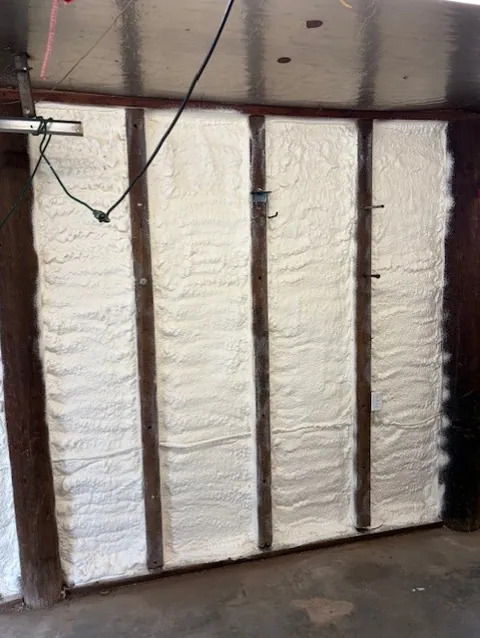
Every Stud Bay Filled
No gaps, no compression, no missed corners — closed-cell foam expands to fill the entire cavity and bonds to the framing.
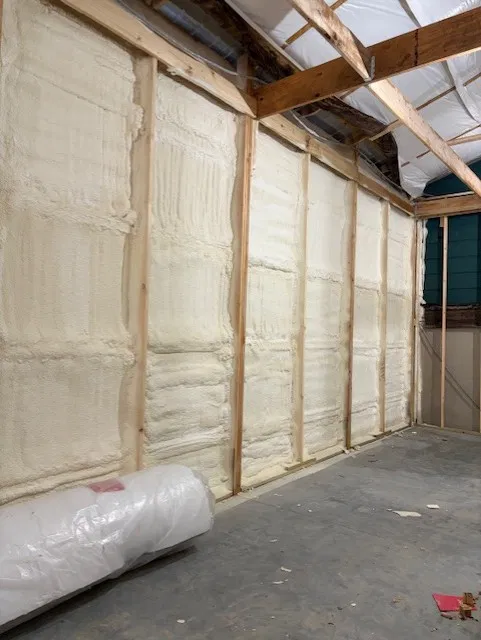
Residential Addition
Every stud bay filled edge to edge on a home addition, ready for drywall to go up right behind it.
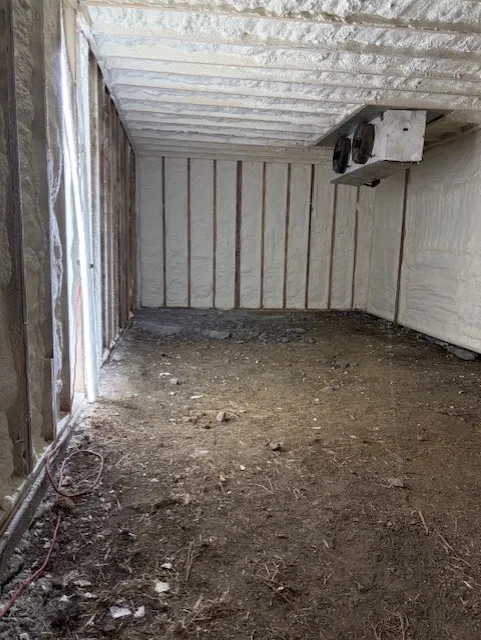
Wall-to-Ceiling Coverage
Walls and ceiling treated as one continuous envelope where the two meet, with no gap left at the corner.
What to Expect on a Wall Job
- 1
Walkthrough
We confirm which walls are open and accessible, check wiring and plumbing, and plan foam type per wall.
- 2
Prep
Anything nearby that needs to stay clean gets masked off before spraying starts.
- 3
Spraying
Foam is applied in controlled passes to fill each stud bay completely and reach the target thickness.
- 4
Trim & Hand Off
Excess foam gets trimmed flush to the framing, and the wall is ready for drywall right behind us.
Wall Insulation: Quick Answers
Can you spray foam insulation into walls that are already finished with drywall?
Should I use open-cell or closed-cell foam for walls?
What are the signs my walls need better insulation?
How much does wall insulation cost?
Is spray foam insulation guaranteed?
Framing Up or Remodeling? Let's Talk Walls.
Tell us a little about your project and we'll call you back — usually the same business day.