Pole Barn & Ag Building Insulation in Manhattan, KS
A bare metal roof sweats. That condensation drips onto whatever's parked or stored underneath, and it doesn't stop on its own. We spray closed-cell foam directly to the roof deck and walls of pole barns, shops, and livestock barns across the Flint Hills so that stops being a problem.
The Problem With an Uninsulated Metal Building
Metal conducts heat and cold fast, and it doesn't hold onto either one. On a cold morning, warm moist air inside the building hits that cold metal roof and condenses — the same way a cold glass of water sweats on a summer day. In a pole barn, that shows up as water dripping from the ceiling onto tools, equipment, feed, or whatever else is stored underneath.
Over time that moisture leads to rust on equipment, rot in wood framing, and mold in feed or hay storage. Closed-cell spray foam sprayed directly to the underside of the roof deck stops the metal from ever getting cold enough on the inside to cause that condensation in the first place — and it adds real R-value on top of that, so the building actually holds a temperature instead of matching whatever it is outside.
Buildings We Insulate
A machine shed, a livestock barn, and a shop all have different demands — we scope the job around what your building actually holds and how it's used.
Metal Buildings
Roof deck and wall panels sealed to stop condensation and hold a stable temperature year-round.
Learn More →Morton-Style Buildings
Post-frame construction insulated between the girts and purlins without losing usable interior space.
Learn More →Agricultural Buildings
Equipment storage, machine sheds, and general farm buildings insulated to protect what's inside.
Learn More →Livestock Barns
Insulation that helps regulate temperature swings for animals while controlling moisture buildup.
Learn More →Running a business out of your building instead? See our commercial spray foam services →
See a Pole Barn Job From Start to Finish
Real photos from our own jobs — the roof deck getting sprayed, a building framed and ready, and the finished interior coverage.
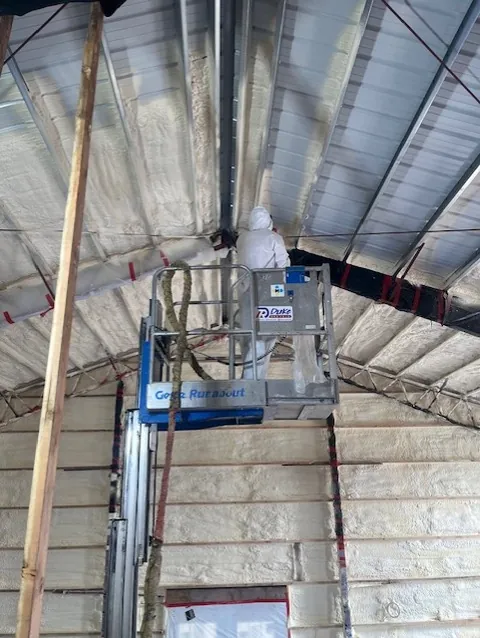
Sealing the Roof Deck
Closed-cell foam sprayed directly to the underside of the roof panels — this is the surface that causes condensation if it's left bare.

Framed and Ready
Wall studs up against the metal panels. We walk the whole building and plan out coverage before the foam gun comes out.
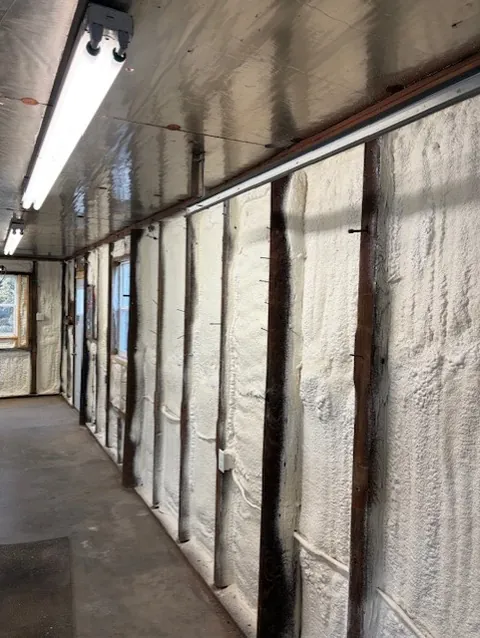
Wall-to-Ceiling Coverage
Walls and ceiling treated as one continuous envelope, with no gaps left for condensation or drafts to find their way through.
What to Expect on a Pole Barn Job
- 1
Walkthrough & Access Plan
We look at ceiling height, roof pitch, and how equipment is stored, and plan access with a lift where the roof deck needs it.
- 2
Prep
Equipment gets moved or covered, and anything that needs to stay clean gets masked off before spraying starts.
- 3
Spraying
We typically spray the roof deck first, then the walls, building up to the thickness the project calls for.
- 4
Cure & Cleanup
We follow manufacturer re-entry times, then clear our own scrap and equipment before handing the building back over.
Pole Barn Insulation: Quick Answers
Is spray foam insulation safe?
Can you spray foam over existing insulation?
How much spray foam insulation do I need?
Will spray foam void my roof warranty?
Is spray foam insulation guaranteed?
Ready to Stop the Dripping Ceiling?
Tell us a little about your building and we'll call you back — usually the same business day.
Timing is everything on a new commercial or agricultural build that fits your insulation needs. Spraying foam insulation after framing—and before mechanical systems or wallboard are installed—creates an airtight barrier that protects structural steel and wood framing from condensation. Explore our complete new construction insulation solutions to see how we keep job sites on schedule and built to code.