New Construction Insulation in Manhattan, KS
The best time to insulate a building is before the walls are closed up. We work directly with builders, general contractors, and owner-builders across the Flint Hills to spray foam new homes, shops, and commercial buildings during framing — before drywall goes up and access disappears.
Why New Construction Is the Best Time to Insulate
Once drywall goes up, insulating a wall means opening it back up — cutting, patching, and repainting on top of the insulation cost itself. During framing, every wall and ceiling cavity is fully open and accessible, which means we can spray complete, even coverage into every stud bay without working around finished surfaces.
It's also the point where foam type and thickness can be planned deliberately for each part of the building rather than retrofitted around what's already there — closed-cell on the rim joist and crawl space walls, open-cell or closed-cell in the main walls depending on budget and climate goals, all decided before the framing crew even leaves the site.
Builders, General Contractors & Owner-Builders
Whether you're a GC running multiple builds or an owner-builder managing your own project, we fit into your schedule instead of the other way around.
General Contractors
We coordinate directly with your framing and rough-in schedule so insulation doesn't become the thing holding up drywall.
Owner-Builders
Managing your own build? We'll walk you through foam type and thickness decisions in plain terms, no jargon required.
Spec & Custom Home Builders
Consistent, code-compliant insulation across every home in a development, with the same crew and standard every time.
Residential Details →New Ag & Commercial Buildings
New pole barns, shops, and commercial builds insulated from the start, before condensation or code issues become a retrofit problem.
Pole Barn Details →Framed and Ready, Then Fully Sealed
Real photos from our own new construction jobs — open framing ready for insulation, and finished wall-to-ceiling coverage on a completed build.
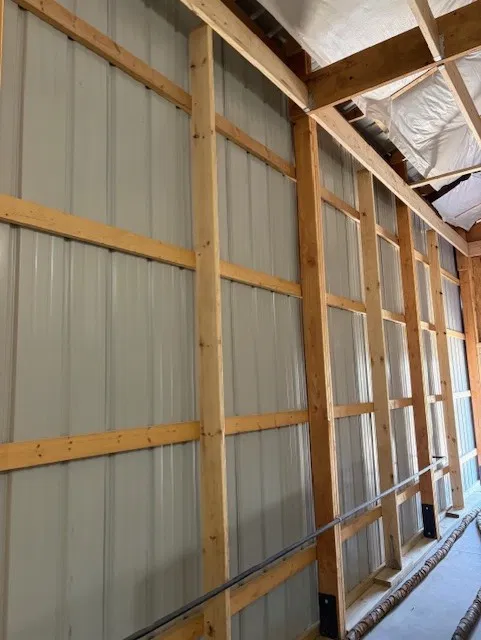
Open and Ready
Wall studs open and accessible, wiring already run — exactly the stage in the build where spray foam goes in.

New Commercial Build
Same principle on a larger scale — walls framed against the metal exterior panels, ready for a full insulation pass before interior finishes begin.
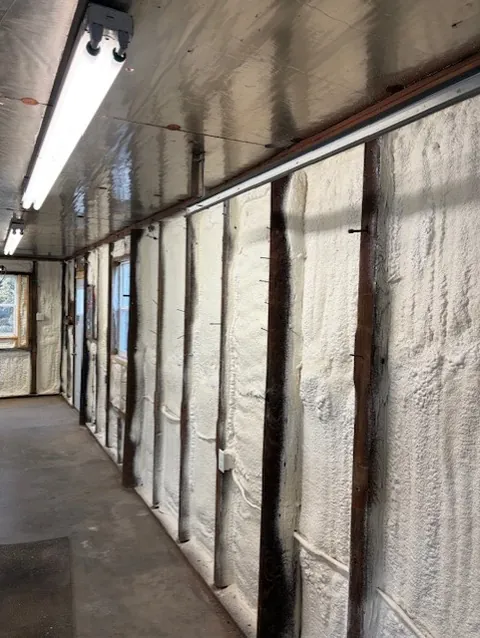
Full Envelope Coverage
Walls and ceiling treated as one continuous envelope, fully sealed and ready for drywall to go up right behind us.
Where We Fit Into Your Timeline
- 1
Framing & Rough-In Complete
Electrical, plumbing, and HVAC rough-in are finished, and wall and ceiling cavities are open and accessible.
- 2
Pre-Spray Walkthrough
We confirm foam type and thickness plan for each area, and check for anything that needs masking or special attention.
- 3
Spraying
Foam is applied in controlled passes to reach the target thickness in each area of the building.
- 4
Trim, Inspect & Hand Off to Drywall
Excess foam gets trimmed flush, the job is ready for any required inspection, and drywall crews can move in right behind us.
New Construction Insulation: Quick Answers
When should insulation happen during new construction?
Is spray foam cheaper on new construction than a retrofit?
Do I need a permit for spray foam insulation?
Can you work directly with my builder or general contractor?
Is spray foam insulation guaranteed?
Building New? Let's Get It Scheduled.
Tell us where you're at in the build and we'll call you back — usually the same business day.